---
title: "Field Modifiers"
url: "https://help.quartet.pro/en/article/field-modifiers"
language: "en"
last_updated: "2026-10-28T18:32:37.885Z"
---
# Field Modifiers
Field modifiers allow for specifying certain additional conditions for the search.
### Text Field Modifiers
| **SFLD:** | Single Field Modifier
Terms appear within the same field within a family. | **SFLD:**TAC=(personal AND computer)
*(Results include families where personal and computer both appear in the Title, Abstract, or Claims)* |
| --- | --- | --- |
| **SPUB:** | Single Publication Modifier
Terms appear within the same publication. | **SPUB:**TAC=(personal AND computer)
*(Results include publications where personal and computer both appear in the Title, Abstract, and/or Claims of the same publication)*
**SPUB** can also be used across multiple fields. Enclose the fields using brackets \[ \]
**SPUB:**\[CLM=(automobil\*) AND PUBD=2020-01-01\]
*(Results include families with automobile in the claims published on January 1, 2020)* |
With **SFLD:** the expression will be searched within only the same field but can be from any family member.
Taking the previous example wherein Document A contains the word **personal** in its abstract, but not the word **computer**, and Document B contains the word **computer** in its title but not the word **personal**, searching **SFLD:TI/AB=(personal AND computer)** would not return this family, as **personal** and **computer** are in different fields (in the title of Document B and abstract of Document A).
For the search query to return a family, the words “personal” and “computer” must both be in the title or both be in the abstract of family member documents.
With **SPUB:** the expression must exist within one document but can be in any field within said single document.
Taking the previous example wherein Document A contains the word **personal** in its abstract, but not the word **computer**, and Document B contains the word **computer** in its title but not the world **personal**, searching **SPUB:TI/AB=(personal AND computer)** would **not** return this family, as **personal** and **computer** are in different documents despite appearing in the same field in each of the respective documents.
For the search query to return a family, the words “personal” and “computer” must be in either a title or an abstract of the same document.
**SPUB:** and **SFLD:** may also be used across different fields by forming a complex query surrounded in \[square brackets\]. For example the complex query**:**
**SPUB:\[TI/AB=(personal AND computer) AND DES=(laptop AND battery)\]** will return families where **personal** and **computer** are within the title or abstract and **laptop** and **battery** are within the description, all within the same family member document.
### Date Field Modifiers
Date field modifiers are used to specify how a date is searched. By default, all dates in the family will be checked against the search criteria. The date field modifiers specify searching only the most recent or oldest dates.
Further, if entering a date and a country code, Quartet would by default treat a family as a match even if the date and country code were matched in separate family members. This can contribute to noise in the results in cases for publications from a specific country with specific date restrictions. The country code specifier allows the date to be matched to specific country codes.
| **.L** | Latest Date
Searches the most recent date of a date field.
Must be combined with a date field. | **PUBD.L**\=2003:2008
*(Results include families having a most recent publication date within the range of years from 2003 to 2008)*
***PRID.L**\=2003:2008*
*(Results include families having a most recent priority date within the range of years from 2003 to 2008)* |
| --- | --- | --- |
| **.E** | Earliest Date
Searches the oldest date of a date field.
Must be combined with a date field. | **APPD.E**<2001-03
*(Results include families having an earliest application date before March 2001)*
**PUBD.E**<2001-03
*(Results include families having an earliest publication date before March 2001)* |
| **.CC** | Country Code Specified
Limits the search of a date field to a desired jurisdiction that is specified by the two-letter country code, where **CC** is the country code.
Must be combined with a date field. | **PRID.US=<**2002-01-10
*(Results include US publications having a priority date on or before January 10, 2002)*
**PUBD.DE<**2002-01-10
*(Results include German publications having a publication date on or before January 10, 2002)* |
| **.L.CC**
**.E.CC** | .L and .E can be combined with the country code modifier. This will search against the latest or earliest date associated with a specific jurisdiction | **PRID.L.US=<**2002-01-10
*(Results include US publications having a latest priority date on or before January 10, 2002)*
**PUBD.E.DE<**2002-01-10
*(Results include German publications having an earliest publication date on or before January 10, 2002)* |
### Tip on searching date limited country code
There are two methods on this page which work for limiting publication dates to specific jurisdictions, the **SPUB:** or the **.CC** field modifiers.
Both have their use cases, which will be shown below, starting from where they are the same:
**SPUB:\[PUBD=2004-01-01 AND CC=(US)\]** is equivalent to **PUBD.US=2004-01-01**
Both return only families with US documents published on January 1, 2004.
**.CC** can be helpful when there are a few or one jurisdictions to be limited to, such as in an invalidity search, when looking for a priority date for US documents, but a publication date worldwide. This could be seen with
**(PUBD<2016-01-18 or PRID.US<2016-01-18)**
Which looks for any family published before January 18, 2016, or families with a US document with a priority before January 18, 2016.
SPUB: can be more useful for searches such as Freedom-to-Operate, where a publication date for multiple jurisdictions is preferable.
For example, if conducting a search limited to JP, KR, CN, CA, US, and WO published before October 26, 2006, then
**SPUB:\[PUBD>2006-10-26 AND CC=(JP or KR or CN or CA or US or WO)\]**
Would be easier to type than the equivalent
**(PUBD.JP>2006-10-26 or PUBD.KR>2006-10-26 or PUBD.CN>2006-10-26 or PUBD.CA>2006-10-26 or PUBD.US>2006-10-26 or PUBD.WO>2006-10-26)**
And would return families with JP, KR, CN, CA, US or WO documents published since October 26, 2006
Note that .CC limits the jurisdiction of the of the results, not the jurisdiction of the priority claim itself.
For example
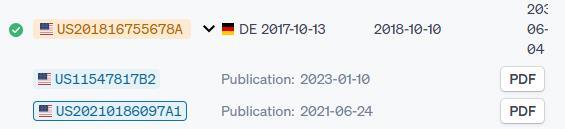
Would show up under the search **PRID.US<2018-01-01**, even though the priority claim is to a German publication. This is because the US document has a priority claim earlier than January 1, 2018
### Assignee Field Modifiers
Assignee field modifiers search original and current assignees. By default, Quartet would search both fields for an assignee match without current or original assignee being specified.
| **.C** | Current assignee | **PA.C**\=(University 2D California)
*(Results include families with a member assigned to the University of California)* |
| --- | --- | --- |
| **.O** | Original assignee | SPUB:\[**PA.O**\=(University 2D California) AND PUBD=2020\]
*(Results include publications originally assigned to the University of California and published in the year 2020)* |
In some instances, current assignee may also be the original assignee.